
By Rachel Cohen
Today England manager Sarina Wiegman announces the November Lionesses squad for the next round of Nations League games. It is unlikely to contain many surprises.
But just over a week ago Wiegman was at Brisbane Road watching a hard-fought draw between Spurs and Liverpool. This is, as far as anyone can recall, her first visit to Spurs’ home ground. Most probably she was there to watch Grace Clinton, a loanee from Manchester United who has been having a great early season with Spurs, culminating in a spot in the most recent Lioness squad. Alternatively, perhaps Wiegman was scouting one of several young Liverpool players. Perhaps defender Grace Fisk, who like Clinton has featured across England’s age group squads.
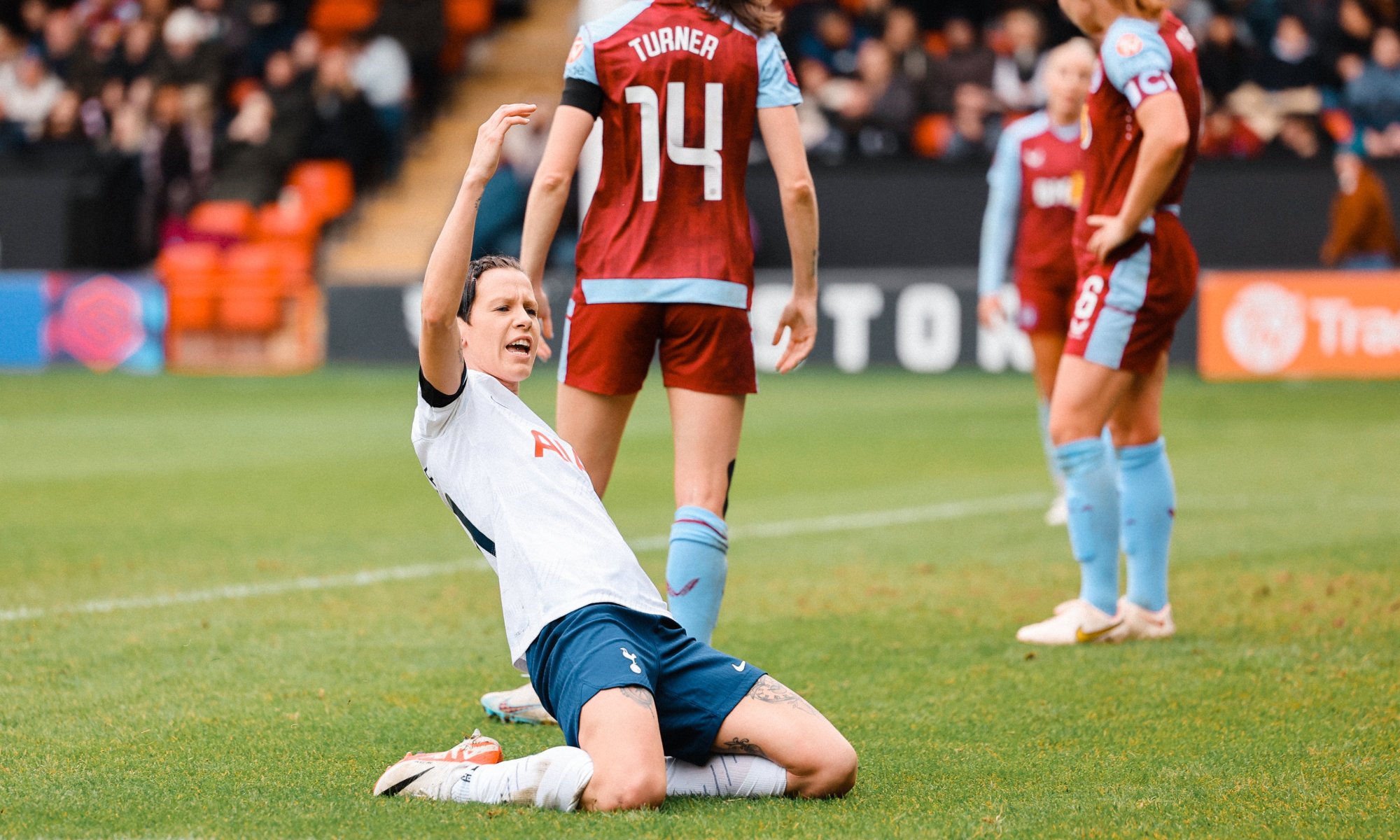
On the day, however, the English player who likely most impressed was someone who has been consistently overlooked by Wiegman and never been part of an England squad at any age level, Ashleigh Neville.
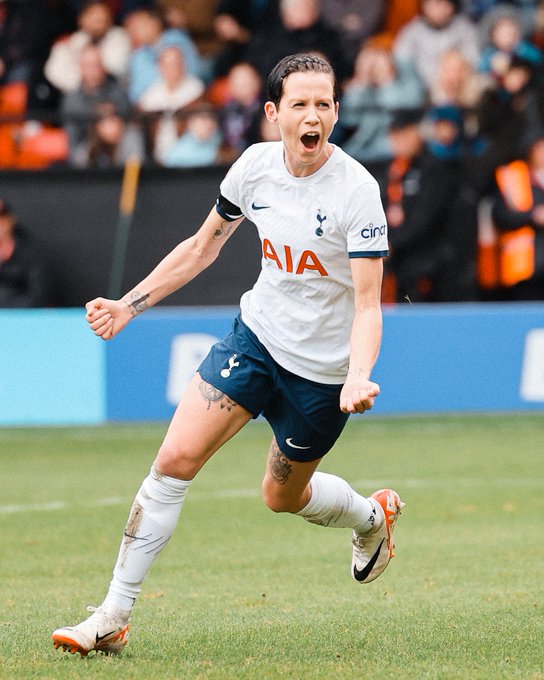
Before going any further it is worth acknowledging that most of the points contained below are not new. But sometimes shouting into the void is all that there is.
Back in Spring 2022 I first wrote about Ashleigh Neville’s exclusion from the England squad. At that time she was at the end of a stellar season at fullback, had featured in various teams of the season. Meanwhile the Lionesses were relying on a forward (Rachel Daly) playing out of position at fullback.
As we know, Neville did not get a call-up and the Lionesses, including their makeshift fullback, triumphed at the Euros. In the Euros aftermath ‘In Sarina we trust’ became mantra, cloaking the England manager in a near-impregnable criticism-shield.
Nonetheless, come autumn 2022, with several Euro-winners unavailable and Neville again in form – scoring, creating assists and tearing it up in a new position, as a winger – calls for her selection got louder, with even mainstream journalists (who rarely pay close attention to Spurs players) joining the chorus. After all, there were upcoming friendlies with little at stake, she could join a camp, Wiegman could take a closer look at least, what would be the harm?
In the event Wiegman instead gave a first call up to Katie Robinson, a player Neville had turned inside out just days before the announcement (and has done since). When asked about Neville at a press conference Wiegman’s response was vague but dismissive: ‘Ashleigh plays different positions now. Last season she played more as a fullback, this season she plays a little higher up the pitch. At the moment she’s doing a really good job at Tottenham, we choose other players at this moment who we believe are better.”
Within a month of that Spurs went into a slump, losing nine on the trot, and it was clear that there would be no chance of Neville getting into a now World Cup-bound, increasingly settled squad. Instead Spurs fans could content themselves that new saviour, Beth England was selected for the Lionesses (albeit only once she had proved her efficiency in front of goal by scoring 13 goals in half a season). In the event England (the player) even got a few minutes on the pitch and scored a clutch penalty as England (the team) progressed to eventual defeat in the final of the World Cup.
Jump forward to November 2023. The Lionesses are this time competing in the Nation’s League and, for the first time under Wiegman, seem unable to solve the problems other teams produce, with damaging losses against the Netherlands and Belgium, and Olympic qualification at risk.
And once again, Neville is in ridiculous form. Across the various statistical platforms that analyse and score in-game performances and use these to rank WSL players she is consistently in the top ten this season. One of them, FotMob, ranks Neville highest of all WSL players; WhoScored ranks her sixth and SofaScore ninth. Clearly these ‘rankings’ should be taken with a pinch of salt. Football is not ‘just’ statistics. But they are also not based on nothing. And it is notable that every other outfield player ranked in the top dozen on any one of these platforms has been part of their national teams’ most recent squads (with the exception of Leah Galton who has chosen not to be). Even if you go down to the top thirty this is largely still true.
So why not Neville? As previously noted she is positionally adaptable, which is crucial for international football (she has played as fullback, wingback and winger); she is happy going forwards, a requirement for Weigman’s fullbacks and wingbacks; and on the defensive end, her ability to win the ball back through tackles, recoveries and interceptions is outstanding. Indeed, she is the current WSL-leader for tackles won and second for interceptions, something that speaks to her reading of the game. She is also outstanding at progressing play, lying sixth in the league for both the number of her progressive carries and progressive carrying distance. Alongside this Neville is a consistent chance creator, scorer and crosser, and a pretty mean header of the ball (both in defence and attack).

In previous years journalists seeking to explain Neville’s exclusion have pointed to her passing as a weakness, and something that could be costly in international games. But this has been transformed under new Spurs manager, Robert Vilahamn, with Neville’s pass completion jumping from 70 to 78 percent (and is now similar to that of other attacking fullbacks). At the same time she has seen more of ball, and is lying tenth in the league for touches this season. Neville has also suffered from being characterised as a player who fouls a lot, the pantomime baddie booed by opposition fan. but so far this season she has made just four fouls across seven games. Her single yellow card, a (dubious) 25th minute call for time-wasting. Under Vilahamn she is also more positionally disciplined, albeit in a role that allows her scope for creativity.
It is also notable that Neville has thrived under very different managers. Her determination to develop is seen in her progression from lower league to full-time professional footballer in her mid-twenties while working another job. Moreover she has consistently raised her game as the standard of those around her has improved, not just making the leap from Championship to WSL, but upping her game year-on-year to remain among Spurs’ best players in every year since joining the club, even as the team has improved.
So, with all that in her favour, is the problem just that Neville does not fit? After all, even in aesthetic terms, her short black hair is a sharp juxtaposition with the blonde ponytails that dominate the Lioness squad. More concretely, her career path is unusual for a player of her quality. First, Neville turned professional much too late to experience England’s youth setup and so, unlike most current England players, has no age-group experience with the national team. That makes her an unknown entity to England national team staff. Second, she plays for a side (Spurs) that are less well established, have struggled, and have never had a Lionesses within the squad until Beth England, and now Grace Clinton (who is often anyway listed as a Manchester United player). They are less closely watched by women’s football media and commentators.
Third, let’s face it, Neville is ‘old’, having turned 30 last Spring. That means she is unlikely to be part of the long-term plans for the Lionesses. Although, that said, there is a good chance that Wiegman leaves her post well before Neville ages out. More importantly, focusing on Neville’s chronological age misses some obvious points. Anyone watching her play will observe that she is visibly stronger and less likely to tire than most players – indeed she has played every minute of Spurs’ first seven games this season. Moreover, precisely because she went full time later than others, she has experienced less physical wear than other players of her age and is probably better equipped to play on for longer. And finally, age is clearly not a critical impediment; last year Wiegman called up Laura Coombs at 32. Unlike Neville, Coombs has been in England youth and senior squads, albeit not since 2015.
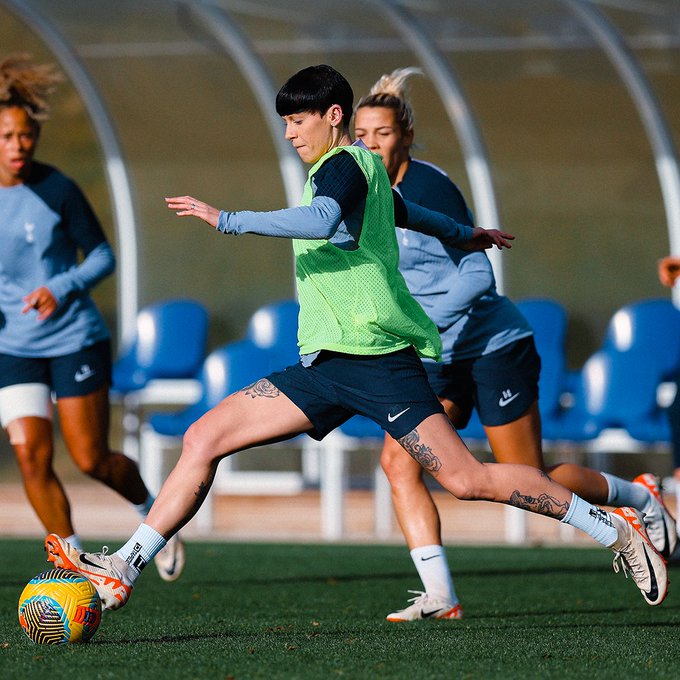
This is not to ignore that there are currently two excellent players at fullback for the Lionesses. Notably Niamh Charles is having the season of her life at Chelsea, while Lucy Bronze despite being a little off her absolute peak, remains imperious. But there are not backup to Charles and Bronze of similar stature or profile. That means there is clearly still scope for Neville’s inclusion – even if just as an experiment – to see whether she might fit better than expected within the setup and squad.
All the above notwithstanding, and however good the case might be, I do not expect Sarina Wiegman to change her mind or to include Neville in this or in a future squad. Although, of course, I would love to be proved wrong. And, as the manager who can claim to have lead England to their only senior tournament trophy in fifty-plus years, I guess she has earnt the right to make the call. But it is still a shame. Especially with an England team that sometimes seems to run out of ideas. Because, as a Spurs fan I can tell you there is little better than watching Ash Neville in full flow; singlehandedly taking the game to opponents, killing it at both ends, making a ridiculous recovery, playing a clever one-two or mixing it up with a stupid backheel.
Thank you for reading. If you have comments please leave them below or find Rachel on social media via @Spurswomenblog


Old ?
No way !
LikeLike