
By Harsh Mishra.
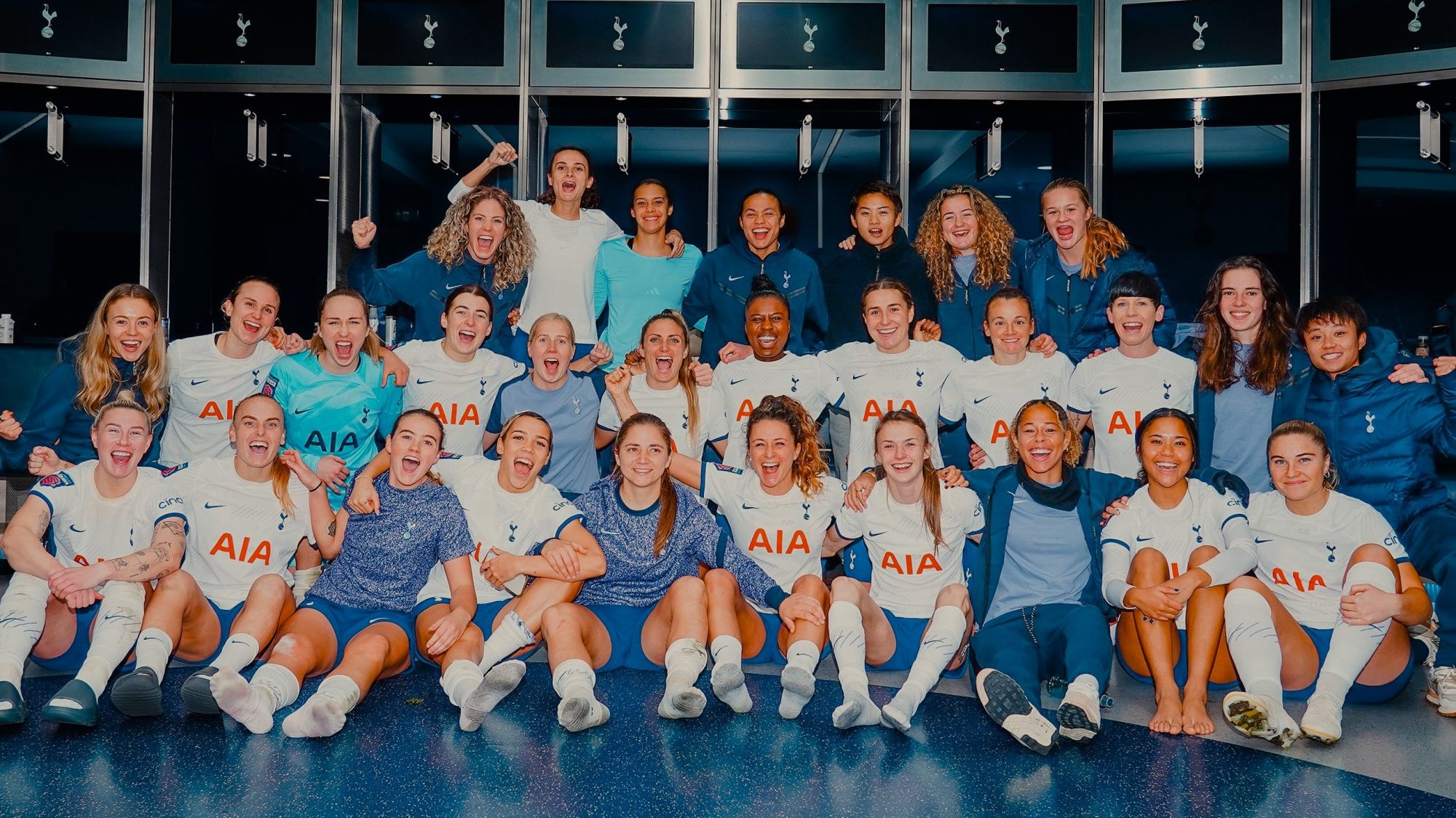
The first home game of the season and the first win of the season! Up against newly promoted, Bristol City, Spurs pretty much wrapped up this game by half time, as they raced to a three goal lead, ending the day 3-1 winners.
Looking at how the teams set up: Tottenham fielded an unchanged side from their first game of the season. But the structure while on the attack looked a little bit different. Compared to the last game, Ashleigh Neville was given more freedom to push up and often was the widest attacker on the left and in the same line of attack as Grace Clinton. Whereas against Chelsea, it felt like a traditional inverted winger and overlapping full back partnership.
Without the ball, which they were for most of the game, Bristol played a 442 mid block, which transitioned into a 4411 when Spurs were able to get past their first line of pressure. One of the strikers would drop in to mark one of Tottenham’s 2 midfielders closest to the ball, while the other one would stay close to the Spurs center backs. The Bristol attackers were also very flexible in interchanging their roles. There were instances when Carrie Jones, who started as the left winger, would swap positions with the striker Ffion Morgan. This is reflected in their average positions below. On the ball, Bristol mostly played it long; trying to regain the ball high up the pitch and playing from there on, rather than trying to play through the third. This also is reflected in their pass map, with the average on the ball locations of players high up the pitch, with very low number of successful passes in-between them.
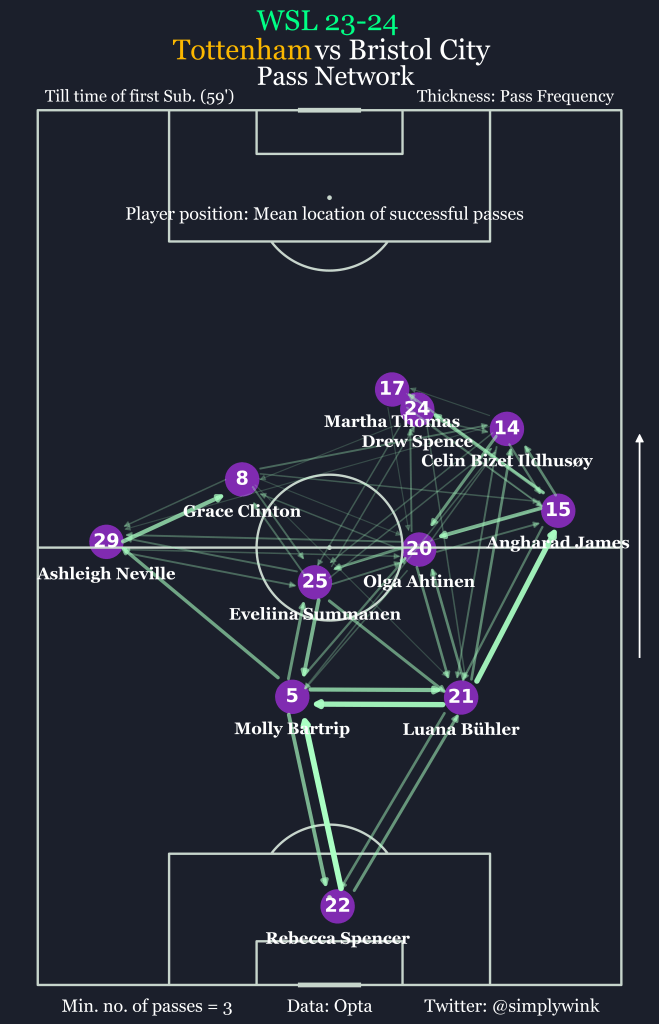
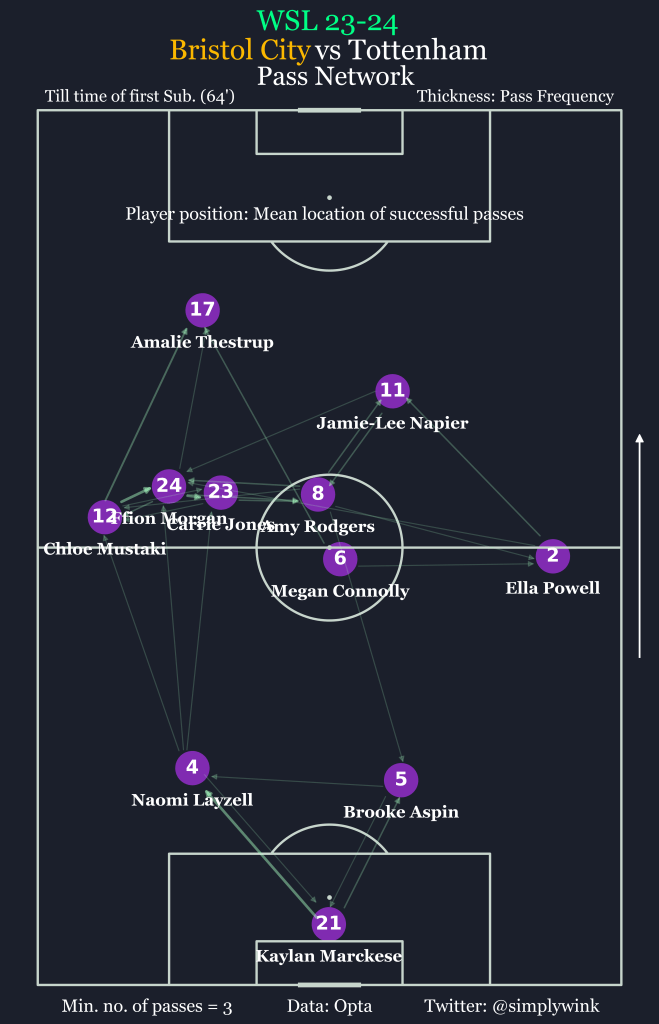
Pass Network Maps for Tottenham vs Bristol City
Coming onto Tottenham’s first goal of the game. As seen in Spurs’ pass map above, there was a huge right side overload, that was created by Drew Spence moving into that area and sometimes creating a close-knit space of five players in the right side of the pitch. This eventually led to the opening goal, as the ball was was quickly moved from the overloaded right hand side to the left, with Eveliina Summanen smartly playing the ball square to Olga Ahtinen in acres of space. The overload and quick switch, along with the stretched distances between Bristol City’s lines eventually led to Ahtinen getting the time and space to place her shot in the bottom left of Kaylan Marckese’s goal. The midfielders and the defenders had dropped too deep into the box, and neither of the two Bristol strikers tracked back in time to close down Tottenham’s midfielders. Robert Vilahamn also pointed to this in his half time team talk, the video of which was released on twitter by Spurs Women, but was subsequently removed. He praised the swift movement of the ball from right to left for the goal and wanted Ashleigh Neville to also stretch the play on the left, to create similar switching chances to the right, whenever possible.
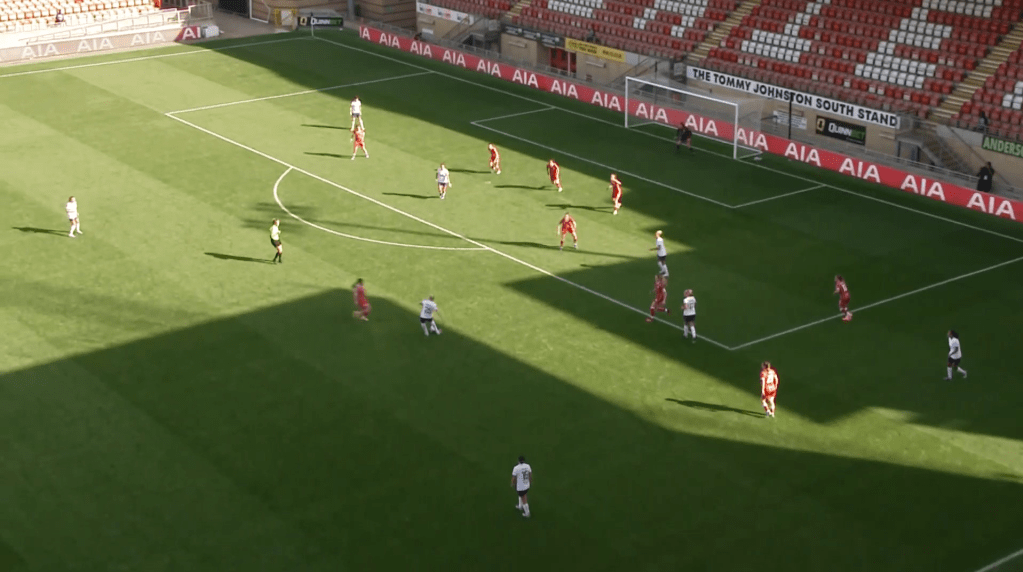
Screen grab just before Eveliina’s assist to Olga’s goal.
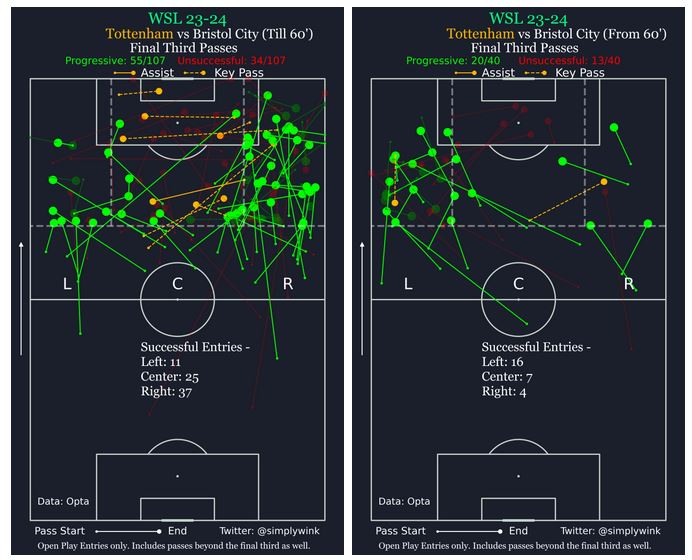
And this preference to attacking from the right side was a common occurrence until Tottenham’s first substitution, when Jessica Naz came on for Grace Clinton. Spurs’ passes into the final third when divided by verticals on the pitch (below) shows the right sided dominance in their attack. This was then flipped when Naz came on, as Tottenham then found it easier to work on the left side of the pitch, with Naz and Neville combining up the pitch, with one touch passes a couple of times.
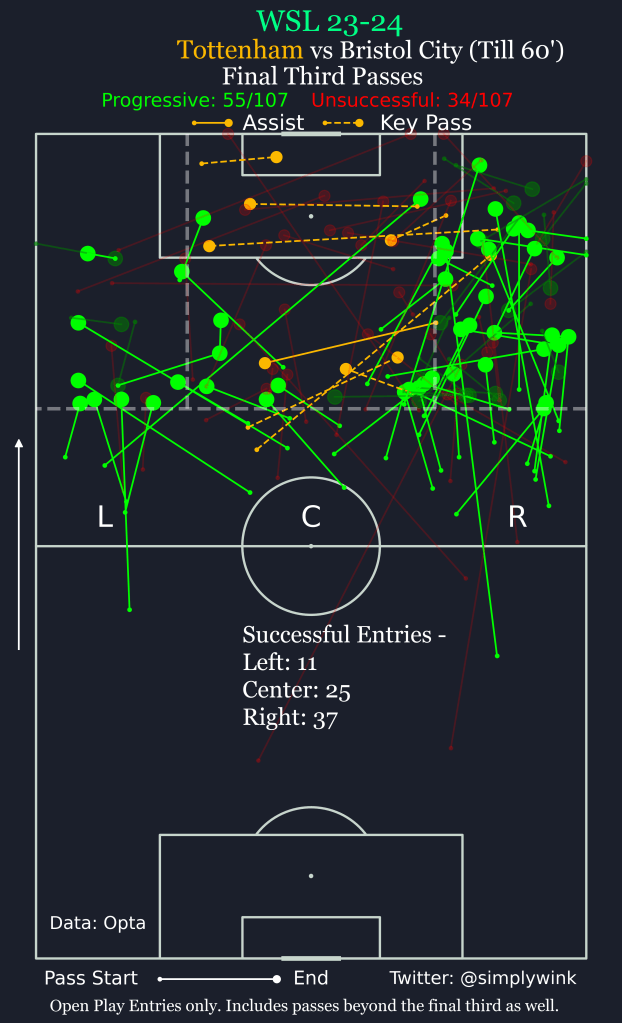
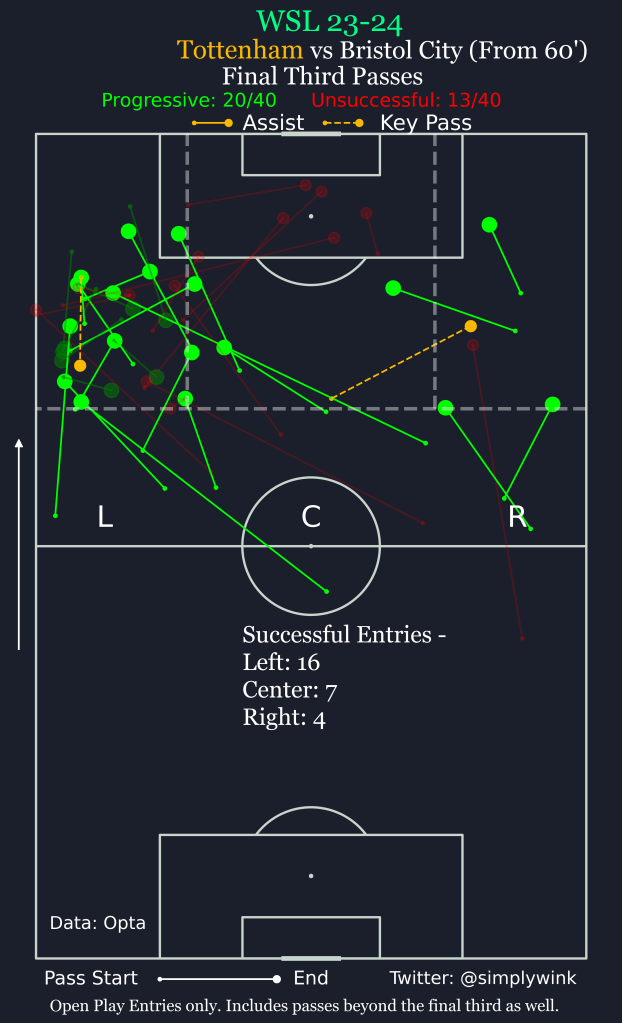
Tottenham’s passes in the final third of the pitch, before and after Jessica Naz coming on
As also hinted at in Vilahamn’s speech at half time, I feel the preference for attacking from one side or other is more to do with personnel and relationships, rather than an out and out tactical thing. The attackers and the midfielders all being right footed means that it is easier for them to drop into that space and play quick short passes or look for channel balls on the right, for players to run on to. Clinton’s playstyle exacerbates this, as she mostly likes to stay in the half space or in between the lines (pockets, as Vilahamn called them in his speech), and then look for a pass inside. Conversely, Naz, being a natural winger, likes to carry it up the pitch, while also combining with the full back.
Defensively Spurs played a fairly good game, with the caveat being that Bristol are a newly promoted side. There were, however, a couple of promising counter attacking situations that Bristol generated. These mainly came as a direct consequence of Spurs pushing lots of players into the attack on the right side. Bristol were then able to intercept a pass and spring the super-quick Ffion Morgan into an in-behind run, that lead to a high quality 1v1 chance for the Welsh striker. Carrie Jones had a very good opportunity in a similar way. But Spurs largely controlled the breaks well and managed to keep the ball in Bristol’s half for long spells. It was the second half before Bristol had some good spells of chance creation, and managed to score a goal from the penalty spot. But the game was more or less done by then.
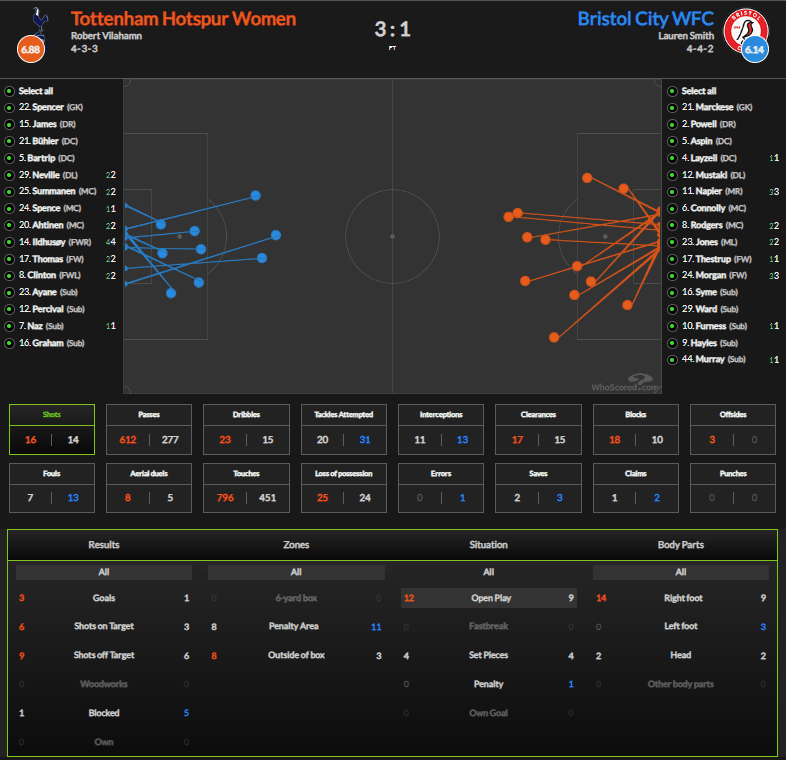
Open play shots from Tottenham vs Bristol
The other thing that Vilahamn might like to address is the lack of goals from natural conclusion to moves. What I mean is that Spurs were able to make some really good plays leading the ball into the penalty area, but then failed to either find the final pass or a player in a better shooting position. Out of the 6 open play shots that Spurs took from inside the penalty box, only 2 of them were from a distance closer than the penalty spot, but both of those shots were from beyond the width of the goal post. I feel Vilahamn will definitely want to work on cutback situations and better decision making when in the final third.
That’s all for this time! In the next week’s version, I also hope to have a brief on the Conti Cup game against Reading, this Wednesday.
Thanks for reading.
Please share your thoughts in the comments section below or find Harsh Mishra on Twitter.


3 Replies to “Data Breakdown: WSL Game 2: Bristol City at Home”