
Tottenham Hotspur Women are not manager-less any more! But most of us know little about Spurs’ incoming manager. To rectify this Harsh Mishra takes a deep-dive into how Robert Vilahamn set up his previous team, Häcken and what that might mean for Spurs.
It’s been almost 4 months since Rehanne Skinner was fired as the Spurs Women’s Manager, following which I wrote a piece looking at potential reasons for her dismissal. Skinner’s assistant Vicky Jepson was then named as the interim-manager until the end of the season. So technically Spurs Women have been without a manager since 27th May.
In that time there was remarkably little speculation about who the next boss would be until minutes before Spurs announced that 40 year-old Swede, Robert Vilahamn, was taking over as Head Coach.
Background: Vilahamn took charge of the Swedish top tier women’s side, Häcken, in late October of 2021. At that time they were more or less destined to finish second behind Rosengård in their domestic league. The next season, 2022, Vilahamn again secured a second place for his side, once again behind league-winners Rosengård. At the time of Spurs’ announcement (July 7 2023), Häcken are leading the league by 6 points, with 9 games to play.
I had no prior knowledge of Robert Vilahamn or Häcken so all opinions in this piece are based on what I could research after his announcement. In case you notice errors or feel that my assumptions are wrong, please let me know.
I could not find full matches from the Swedish Women’s league, Damallsvenskan, freely available, so for this article I primarily watched games from the Women’s Champions League. Häcken had already played two games of the CL 2021-22 group stage when Vilahamn took over the side. They eventually finished last in their group, with a win and five losses. For season 22-23 (last season), they failed to qualify for the group stages, after losing to PSG in the second round of qualifying (aggregate 4-1).
To give an idea of the quality difference between the Swedish league and the Women’s Champions League, Rosengård, who qualified for CL 22-23 group stages as 2021 Damallsvenskan league winners, also finished last in their group with 0 points.
I chose four games to watch: two against Benfica, from the CL 21-22 group stage, and the two against PSG, from CL 22-23 qualification. Häcken won one of the games against Benfica, making it only their second ever Champions League group stage win in about 11 years. Luckily, they dominated / had plenty of possession in the games against Benfica, so I was able to get a defensive, as well as an offensive perspective of how Vilahamn likes to set up a team.
Offensive Patterns
vs Benfica – November 10th & 17th – 2021

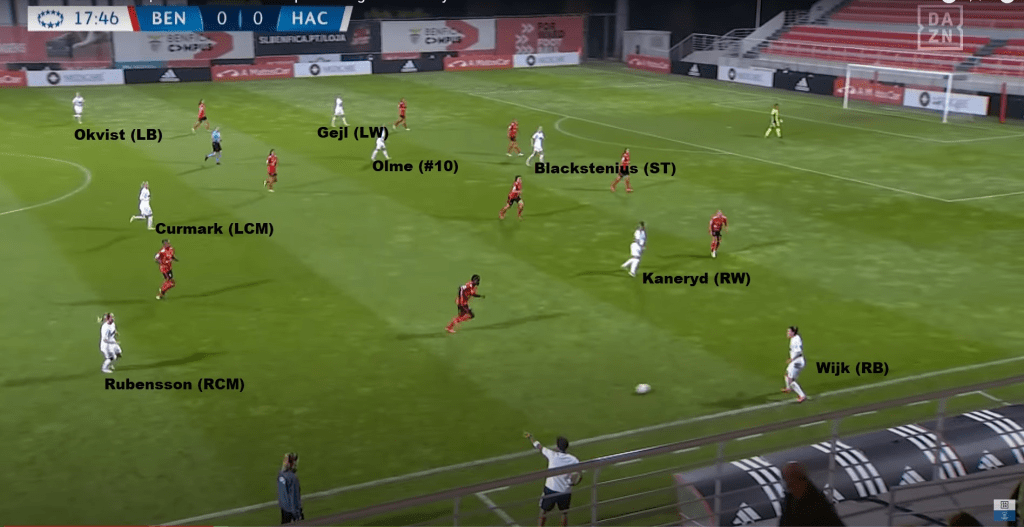
The away game against Benfica in WCL 21-22 was, according to the commentator, Vilahamn’s third in charge of Häcken. As show by the above image, he was taking over a side in transition. Kullberg and Olme’s contracts ended at the full time whistle and they did not play the return leg on November 17th. Stina Blackstenius’ contract was also up at full time. She signed a short term extension before eventually heading out to Arsenal, but was unavailable for the return leg, due to injury. Fast forward to the current season, goal keeper, Falk, and right back, Wijk are core starters. The midfield duo of Rubensson and Curmark played 11 and 7 games out of 17 respectively, while Stine Larsen (on the bench, above) has only played in 3 games. Others marked “still at the club” in the above image, haven’t got any minutes yet this season or are out on loan.
Despite what the above graphic suggests, Vilahamn set up his side to play in a 4231 off the ball, which sometimes moved to a 442. Blackstenius lead the line, with Gejl, Kaneryd and Olme the three behind her, and Rubensson and Curmark the 2 in front of the defence. The set up did not change for the return leg, although Karlenas came in place of Olme as the number 10, Blackstenius was replaced by Larsen and Kullberg was replaced by Kollmats.
In both the games the Swedish side had majority of the possession and looked to largely play out of the back, with their CB’s not attracting much pressure from the Benfica forwards. Their settled attacks from deep followed a specific pattern, one of the CMs moved out wide, mostly Rubensson, – into the space vacated by the pushed-up right back.

This is something a lot of teams do – fasten their build-up and make it less risky, by building up from wide areas. But in this case, it maximizes Rubensson’s passing abilities and also gets her into familiar positions – she has played all across the right wing (at right back against Bayern & Lyon, prior to the Benfica game, and at right wing in past seasons and more recently).

While the build up took shape, the role of the forwards (as well as the #10 + right back) was to occupy different channels and pin back Benfica’s back line. This meant that Rubensson could either combine via short passes in the triangle created on the right side, look for direct balls from deep into the forwards, or look for runs in behind. In the above situation she opted for the former, but there were situations where she played direct balls as well (game timestamps for a few of these patterns: 26:45 – first game, 20:02 & 62:10 – second game).
The #10 was mainly tasked with taking up a space in the forward line of five, but there were a couple of instances where she dropped in between the lines and looked for a pass straight from the two CMs.
Once play was in the final third, the ball was often with the widest player, who then looked to either carry it into the box and look for cutbacks or cross from wide. I felt that Benfica did better in the second game to control the pattern that relied on Rubensson being able to hit unpressured passes from the right channel. They did this by either asking one of their front three to shadow her or by overloading the right channel to choke up space. There were also times when Benfica, quick to recognize the pattern, pressurized her well, stopping Rubensson, but letting the RCB play a similar long ball into the channel.
Even though Häcken dominated posession in both games against Benfica, and arguably created on-par chances to win both, their two goals (one in each game) came from penalties. Conversely, Benfica, who won the second game 2-1, playing away, scored both their goals from set pieces. One at each end of the game.
Off the ball, Häcken pressed Benfica high up in a 4231 whenever Benfica looked to build up from the back. The striker took the CB closer to the ball, the opposite side winger took the other CB and the #10 covered the pivot player. When the play shifted towards one side, the far side winger would then tuck into the central space and leave out the full back open. When the opponent had possession in the middle third, the 4231 block was not intense. Häcken were content to let Benfica move the ball out wide but then looked for chances to jump onto the ball near the touchline or intercept passes that tried to play through the block.
Tactically flexible!
vs PSG – September 21st & 28th – 2022
While the games against Benfica were pretty evenly contested, with Häcken enjoying plenty of time on the ball, the 2022 games against PSG were dominated by the heavily-favoured Paris side. As mentioned earlier, Vilahamn had overseen a huge change in his team’s personnel. That he started three players born in 2003 emphasizes that point again.
Playing against a strong opposition, Vilahamn opted to tweak his system and went with, a more passive, 541.

Häcken mostly allowed PSG to build up from the back and only engaged when the ball was in the middle third. The striker was often the only player tasked to pressure the CBs, with the wingers joining when the ball was shifted out wide. Like a usual 433 vs a back five, wide CBs often had to move out of the block of five and into the wide areas to contest 1v1 against PSG’s wingers or pushed up 8s. Other off-the-ball principles felt similar to his 4231 block. The lines stayed intact and in a medium block, making sure the ball wasn’t allowed through the central spaces.
On the 60th minute in the second game, after PSG scored to make the aggregate score 4-1, Vilahamn took off one of the CBs to bring an extra player in the midfield, moving the line of engagement higher.
On the ball, the Swedish side had a very conservative approach in these two games. Stine Larsen, physically impressive at 5’10, was their go-to player. She came in-field during goal kick situations and was the main target for long balls from deep, when wide on the left. From goal kicks, the keeper often called for the CBs to come closer, but then eventually played it long. This occured so many times across the two games that it felt planned. Perhaps it was done to give Larsen time to set up to contest duels or perhaps to spread out PSG’s lines, under-crowding the landing area. I am not really sure. The plan did work out once at least, with PSG’s left back misreading one of the long balls, which allowed the #10 in that game, Lundin, to score on a 1v1.
As a side-note, throughout these two games I was impressed by the then-19 year-old left-footed, LCB, Elma Junttila Nelhage. She stands at around 5’10 and often dominated in wide duels against Diani and Geyoro. She was also very good at carrying the ball up the pitch and often looked to find a channel ball post-carrying. I list some timestamps of her plays at the end of this piece. She is, however, still not a regular starter at Häcken and is 3rd choice, behind 38 year-old Austrailian veteran, Aivi Luyik, and 25 year-old Swede, Rybrink, who started the games against PSG as the central and right sided Center Backs respectively. In one of the short highlights clips from this season’s Damallsvenskan games, Nelhage was also brought on as a left back. So she is still a developing player, but certainly one to keep an eye on for the future.
Current Season – On the road to domestic champions
Advanced statistics from the Swedish league are nowhere to be found, even the highlights of league games are scarse. From what I could find, however, the current league leaders have conceded the fewest goals so far this season (5), five less than third placed Hammarby. They have scored the second highest number of goals (40), just one fewer than last season’s champion, Rosengård, who are currently fifth in the table.
Häcken’s current run for the Swedish Championship is being spearheaded by the recently-turned 20 year-old, Rusul Rosa Kafaji, leading the team for goals and assists. From the (maximum) three-minute highlights of those few league games that were available on sofascore, Kafaji plays as the #10 in a similar 4231 setup, as above. Anna Anvegard, is deployed mostly on the left, and has same number of goals as Kafaji (10). The right side seems to have rotated between 2 players with WSL connections, Ruby Grant (ex- West Ham & Arsenal) and Julie Blakstad, who was on loan from Manchester City, until mid-June.
Extension to current Spurs squad
The forwards being tasked to always be on the last line and to be surrounded by players across different channels is something that should help Beth England, who often had to create her own opportunities last season. Tasking the #10 to push up alongside other forwards suits Drew Spence (and also Kit Graham), who played a similar role last season. Ria Percival seems to be the best suited to play the “drifting wide CM” role that Rubensson played. Eveliina Summanen is perhaps the closest alternative to the now 33 year-old New Zealand international, although she is much more of a short passer. Keeping Ria’s age in mind, a functional midfielder could be bought this window. Celin Bizet and Jessica Naz’s preference to stay out wide, combined with Neville’s ability to get herself into goal scoring opportunities, could also lead to some fun positional movements on the right side.
At time of writing the contracts of Asmita Ale, Rosella Ayane, Shelina Zadorsky, Kit Graham and Eveliina Summanen are still up in the air, even though the club has an option to extend the contracts of the latter two for a year, which logically they should exercise.
Left wingers have heavily contributed to goal scoring in the two seasons Vilahamn was in charge of Häcken. Even taking into consideration Spurs’ playing style over the last few seasons, Rosella Ayane, Jessica Naz and Celin Bizet are not prolific goal scorers. With Kyah Simon and Chioma Ubogagu’s departure and Ayane’s future uncertain, there certainly is room to bring in a left winger.
Hours after announcing Vilahamn’s arrival, the club also announced the signing of Luana Bühler, a Swiss international center back. I am yet to watch any of her games, but stats show that she is comfortable at passing and carrying the ball. She is currently being touted as a potential replacement for club captain Shelina Zadorsky. With Kerys Harrop and Tinni Korpela’s contracts also expiring, getting a goal keeper and at least one left back is the minimum expected from the club at the moment.

The Häcken team that Robert Vilahamn inherited, itself had 4 examples of players who then successfully transitioned from the Damallsvenskan to the WSL. Time will tell if Spurs utilize the Swedish market and Vilahamn’s expertise about the league to get a few players of their own.
Thanks for reading. Please do share your thoughts in the comments section or on Twitter.
To know more about Vilahamn, I highly recommend listening to this episode of the “Sports CDP Crash Course – Data Talks” podcast.
Timestamps for Elma Junttila Nelhage’s fun clips vs PSG – 1st game: 43:50, 50:23, 56:24. 2nd game: 15:45, 27:22, 73:30, 83:20, 89.
Harsh Mishra is on Twitter @SimplyWink
 Spurs Women Blog
What a great write up Harsh … well done on all the research – just hope he is better than our previous Managers since joining the WSL … only time will tell and then only being offered a 2 year contract maybe even THFC are not so sure neither.
By the way Graham did sign an extention to her contract earlier in the year and maybe you meant to write Gracie Pearse whose contract is up for renewal and I hope she stays as she was not given the chance with Skinner?jessop and is better than Ale imho.
I am not a lover of Ayanne style of play and lazy when it comes to defending and then Ale has not improved at all since joining so I feel they need to be moved on for much better. Trouble is we have still so much deadwood still in the ranks and I think he will have a hard time making a top winning side out of this group even with Buhler joining…. so I hope he is really choosy as to what players come in (not like for likes)
LikeLiked by 1 person
Been nearly a month since this write up and yes I know there is a WC going on how is it the Chavs have brought in 8 players and moved on 3 (that is an extra 5 thus far and I bet they sign even more over the coming weeks) and we have 1 and 6 …. is there nothing going on in our camp? bar management set-up. All the decent players will be gone before we even start looking – we cannot still be waiting for Scott Munns surely?
LikeLike
Now the new GK signing spills the beans that she has been waiting 2 months to join … well that would mean some if not all these new “in” signings have been made before Bob the new builder started. That goes to show that he has been set up to fail even before he started and not been allowed to get his own players in nor that we try get some inspiring WC players in. I may be wrong but I think it is time for our head of the women’s set up to come out behind the sofa and is interviewed on what really is the direction of this club as it aint gonna get better soon is it?
LikeLike