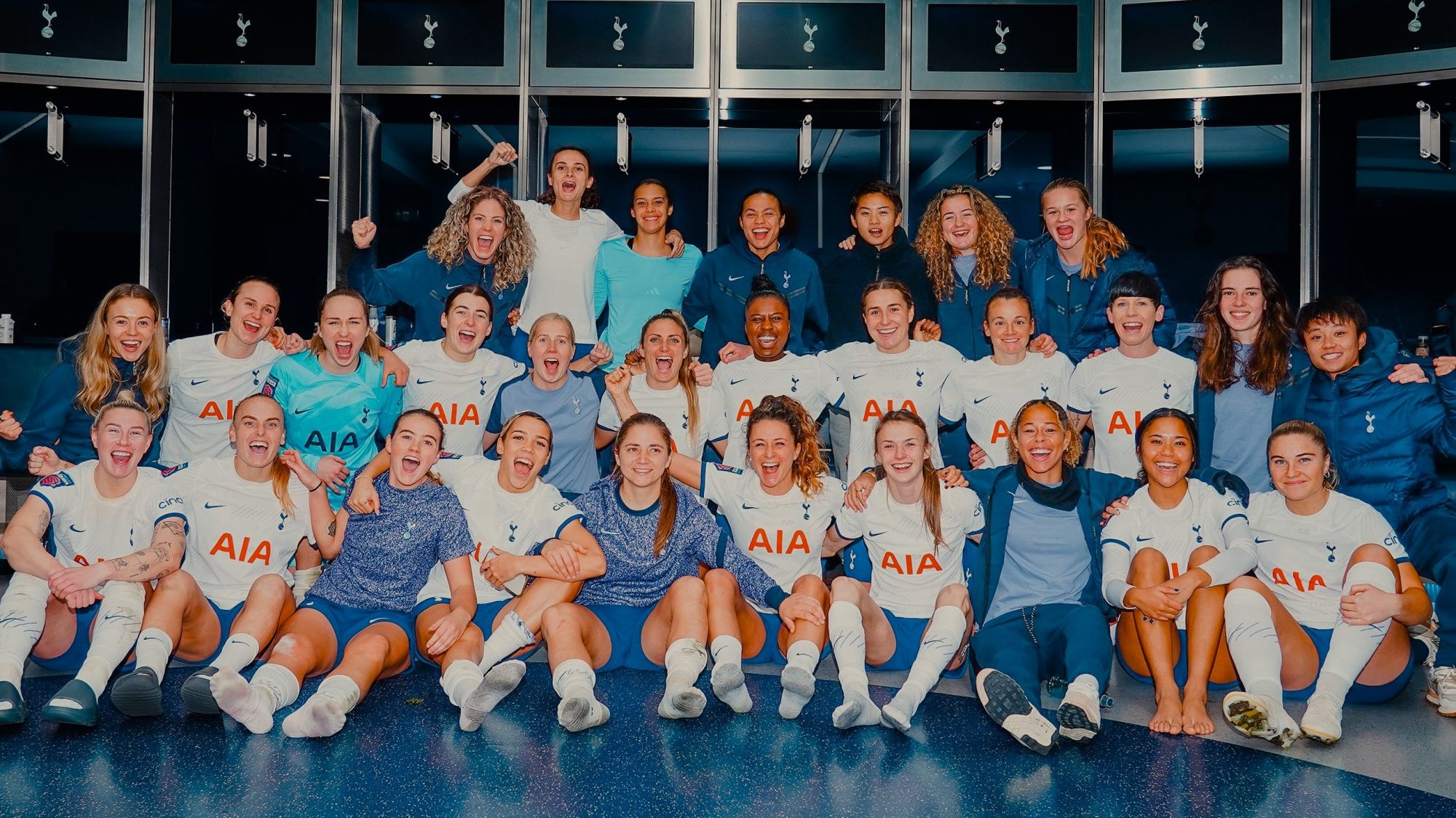


We are 4 games into the 2023-24 season and Tottenham Hotspur Women have already accrued 50 percent of their points tally from the whole of last season. This weekend saw an impressive 4-2 win away at Aston Villa’s Bescot Stadium.
In contrast to last season, Aston Villa have not started this season well, and this was their fourth consecutive loss. But they made a really good start to this game, as Rachel Daly scored from the penalty spot in just the fifth minute. It resulted from a clumsy tackle by Evellina Summanen, when she tried to regain the ball after her touch bobbled into the penalty area. This meant Spurs had the game state against them pretty much from the get go. But Robert Vilahamn’s team stuck to their game plan and came out comfortable winners at the end. Let’s talk more about the game plan from both the sides.
Aston Villa lined up in a 433 shape on the ball, with Jordan Nobbs and Laura Blindkilde Brown playing as the box to box 8s, with Lucy Staniforth at the base of their midfield, Spurs continued their 4231 shape on the ball, but made one change to the starting 11. Jessica Naz who had been making promising cameos off the bench, got a start ahead of Drew Spence, which meant that Grace Clinton moved to the #10.
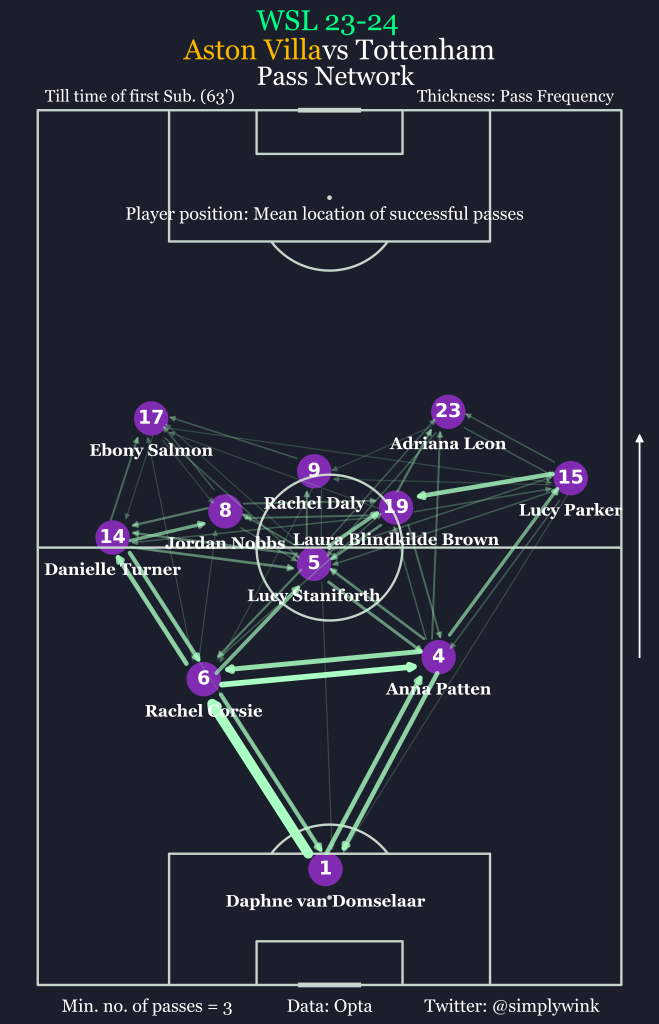
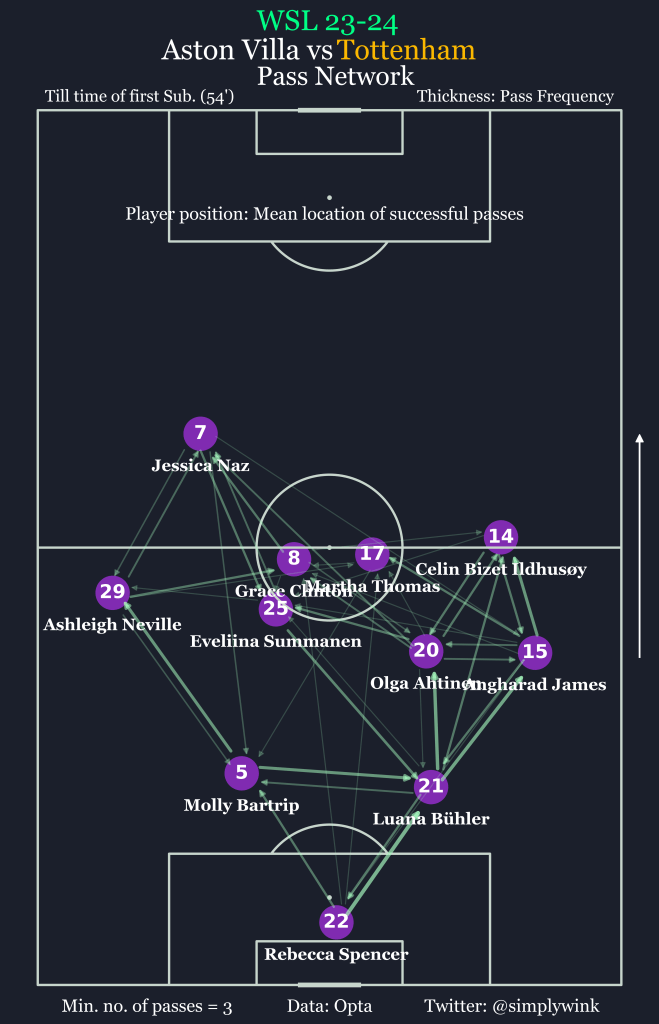
Pass Network Maps for Aston Villa vs Tottenham
Both teams tried to press each other high up the pitch, whenever possible and showed the desire to play through the lines. But there were key differences in their build up ideas. Villa pushed their center backs very wide, forming a diamond shape with their goalkeeper and Staniforth at the other two ends. The CBs spreading out really wide meant that the front two of Spurs’ pressing unit, Martha Thomas and Grace Clinton, had to cover a lot of ground in order to cut off the passing angles. Their initial focus was to cut down the direct passing lane to Staniforth. Based on which side Villa’s keeper passed to, one of Thomas or Clinton would then try to pressurize that CB. A pressing tactic popularly known as a pendulum press. Although with the Villa CBs so wide on the pitch, it wasn’t easy for the Spurs forwards to pressure them.

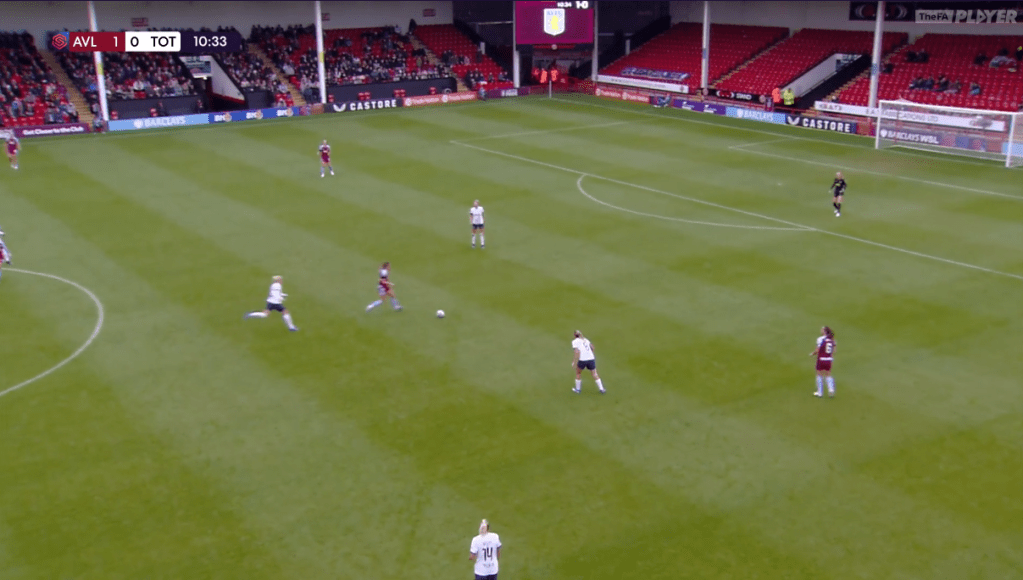

Aston Villa building up with their CBs split very wide
The images above show one of the instances where the Villa CB, Anna Patten, got a lot of time to carry the ball up the pitch and play a line breaking pass into the midfielder, Laura Blindkilde Brown. This was a major issue with Spurs’ press throughout the first half. The broadcast on the FA Player even captured Robert asking Thomas/Clinton to move across faster and to not let the Villa CBs get as much time on the ball. This pattern of play slowly resulted into Spurs having to drop off from their press, in order to make sure that the space in between their lines was harder for the CBs to access.



Martha Thomas pressing Villa’s CBs, just before her 1st goal
Spurs got their equalizer from a similar sequence of Villa build up. In this instance, Martha Thomas moved all the way across the pitch from pressuring one CB, to pressurize the other, intercepted a back pass from Rachel Corsie and coolly lobbed goalkeeper, Daphne van Domselaar. The ‘correct’ press in the above scenario, would ideally have Thomas and Clinton taking over each other’s roles halfway. Which would have meant Thomas moving to marking the #6 and Clinton covering the relatively shorter distance of switching over to the other CB. In this case the press did its job, but in my opinion, Villa being sloppy with the ball played a vital part.
Now moving on to Spurs’ on-ball approach. Quite opposite to Aston Villa’s setup, Spurs opted to buildup with their center backs really narrow and close to the goalkeeper. They have been using this approach through all the televised games under Vilahamn so far. The keeper plays it short to one of the CBs, who have both the midfielders and the full backs at very close distance. The pattern in these build up situations over the games so far has shown Spurs’ inclination to use the right side of the pitch to build up, more than the left side.


Spurs budling up with CBs really close to the keeper
One such instance is shown in the images above. Becky Spencer took a short goal kick to Molly Bartrip, who then played a square ball to Luana Bühler, who despite being under pressure, finds a line breaking ball to Eveliina Summanen. Using such an approach where the players are positioned so narrow, Spurs bait their opposition to press them high, in the hope of findng a way to play through the press and get into the opposition half in a type of transition.


Spurs’ short build up, with Aston Villa’s midfielders joining the high press
Carla Ward, Aston Villa’s manager, wanted her players to push up high in numbers and stop Spurs from playing out, and to look for high turnovers. To do so, she encouraged both her #8s to join the press. Nobbs and Blindkilde would closely mark the two spurs midfielders and Daly would press one of the CBs and push Spurs to play towards the touchline, to trap them. Two instances of these situations, from either halves, can be seen in the above images. In the left image, Spencer eventually opts to play it long, directly to Clinton, who is marked by Staniforth. In the right image, Spurs have moved the ball to the right side, after initial passes between their Center Backs, but both Villa midfielders (#8 and #19) can be seen pushed high up. In this case, Angharad James finds Drew Spence with a cross field ball. You can see Spence checking her shoulders seconds before the pass came to her and realizing that she can take advantage of this situation with her marker, Staniforth, attracted to the side of the ball.

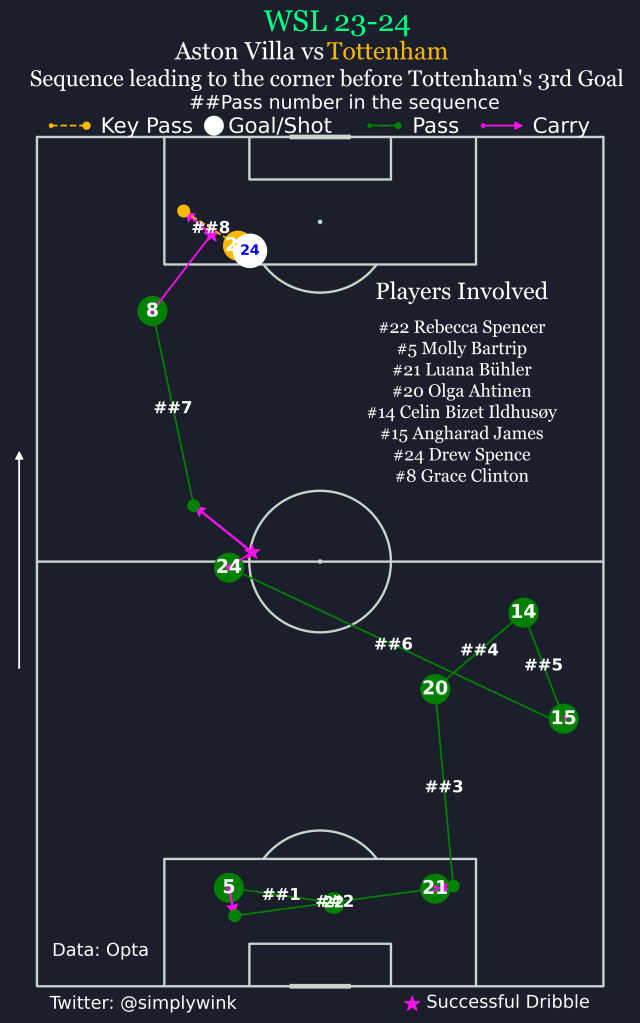
Spurs’ Passing sequences working through Villa’s press
The two maps above show the full sequence of play of the two instances mentioned. In both situations, Spurs bypass Villa’s press by playing it to their #10 (Clinton and, following substitutions, Spence). The first sequence led to Jessica Naz cutting into the penalty area and curling a shot just wide of the post. The second sequence led to Drew Spence forcing a save from van Domselaar. The resulting corner eventually produced Martha Thomas’s second goal, and Spurs’ third.
The game was all but done at this point. Aston Villa committed more numbers to their attacks, looking to get back into the game, leaving space in behind. Thomas took advantage of that and scored her hattrick, after Olga Ahtinen played a line breaking through ball and notched up an assist for the second game running.
It is only fair that I touch upon Spurs’ second goal, which came right at the half time whistle. With seconds left on the clock, Spurs had Aston Villa camped at the edge of their box and Robert Vilahamn was heard shouting “Go for it; Go for it”, and that they did. Jessica Naz, who momentarily moved to the right flank, received a diagonal pass from Eveliina Summanen and put in a cross at the far post, which was headed home by Ashleigh Neville.
This edition of the Data Breakdown turned out to be more of a tactical breakdown than usual, but the tactics is what made the battle especially intriguing. Both sides had different approaches to the build-up and wanted control of different stages of it: Aston Villa wanted more control of the ball during the build-up, whereas Spurs’ approach was to build-up amidst pressure, in order to create artificial transitions further up the pitch.
With the first International Break upon us, Robert Vilahamn should be pretty happy to have seen that his team has shown the courage to play his type football, what he refers to as the Tottenham way! It’s not just the football that has been good so far, but the results as well.
Thanks for reading.
Please share your thoughts in the comments section below or find Harsh Mishra on Twitter.
 Spurs Women Blog
4 Replies to “Data Breakdown: WSL Game 4: Aston Villa Away”